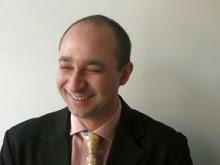
Look at this and select the most likely diagnosis:
1) congenital bilateral ptosis
2) "come hither" look (deliberate & acquired)
3) physiological fatigue
4) myasthenia gravis
5) adverse reaction (levator palbebraei, maxillary, cranial & CNS?) to botulinum toxin
How would you treat this?
1) sit and wait
2) sit and wait and listen
3) elect
4) surgery to shorten levator palpebrae (bilaterally)
5) 3 coffees a la Bal from Ouro Preto
6) A Cuban cigar, at the right time, in the right place, in spite of the Embargo
7) spectacles with ptosis clip
Wednesday, February 27, 2008


Friday, February 22, 2008
Thurs Feb 21, 5p
We covered astigmatic corrections, including power-cross, the idea of crossing 2 cyls to obtain any spherocylindrical dioptric power, axis transposition, with- and against-the-rule astigmatism & it's physiological origins, as well as basic design of spectacle lenses. A water melon from Pete's Frootique helped. Here's the whiteboard - a bit cryptic I fear.

We then tried all the spex sent by Giese Optical International and none of them provided the clear vision we had all looked forward to. But the 200 pairs from VAO arrived this afternoon and are currently soaking in my bathtub (I have two, if you want to visit). I will distribute packs of those to you, together with trial case lenses, for you to practice neutralisation and mark-up of optical centres etc. This is a very useful exercise, methinks, and I promise to include something similar in your April exam. The first step is to figure out what type of lens you're dealing with, the second is to estimate power etc. Here's the whiteboard:

Last, I showed you how to calibrate a focimeter. The blasted thing was broken and I electrocuted by right eyelid. Remember, keep both eyes open and slowly reduce the telescope down until the graticule image first becomes clear.
Get an updated script with an added step-along problem from http://myweb.dal.ca/partes/O4iP_22Feb08.pdf.
Oh, and there is a new treat from the Scary Monkey under Valentine's Day.

We then tried all the spex sent by Giese Optical International and none of them provided the clear vision we had all looked forward to. But the 200 pairs from VAO arrived this afternoon and are currently soaking in my bathtub (I have two, if you want to visit). I will distribute packs of those to you, together with trial case lenses, for you to practice neutralisation and mark-up of optical centres etc. This is a very useful exercise, methinks, and I promise to include something similar in your April exam. The first step is to figure out what type of lens you're dealing with, the second is to estimate power etc. Here's the whiteboard:

Last, I showed you how to calibrate a focimeter. The blasted thing was broken and I electrocuted by right eyelid. Remember, keep both eyes open and slowly reduce the telescope down until the graticule image first becomes clear.
Get an updated script with an added step-along problem from http://myweb.dal.ca/partes/O4iP_22Feb08.pdf.
Oh, and there is a new treat from the Scary Monkey under Valentine's Day.
Tuesday, February 19, 2008
Sessions on Wednesday 20 Feb, 11a and 5p
Thanks to all of you for doing your work on the problem I put. I thought we had a good discussion. Here's a screenshot of the next problem - this is a lot more difficult, and by working through it you will really end up with an excellent understanding of the geometrical optics issues involved in IOL calculations.

Chloe e-mailed me with some questions. I have posted those as a comment on this site, where they belong. Please have a look - if you want to prepare something we can discuss this at the next session.
Tonight there is a lunar eclipse, and we have a beautifully clear sky. I shot this with my Panasonic TMC-TZ3 at 10X zoom. This camera has an optical image stabilizer (OIS) to suppress image motion from tremor etc - one of the most exciting new technologies that are being used in good binoculars but not, as yet (I believe) in low-vision telescopes. Maybe you want to look up how this works - it's great stuff.

Inspired by above, I hoped to inspire you to run you through a list of useful numbers in vision science, assembled by Brian Wandell of Stanford University, during our next session tomorrow (Thurs) 5pm. We also revisited the idea of estimating spectacle prescriptions etc, with and without focimeters. I hate that un-word "lensmeter" because, apart from being ugly, it can lead to confusion with the Geneva Lens Clock - see the site by Mark Wilkinson of Iowa. God Save Our Queen).
Congratulations to Chloe (PGY5) for making an excellent guess on the angular subtense of the moon (0.5 degrees). Twinkle, twinkle, little star. Here is another very British tribute to the Moon - enjoy & watch the teeth!

Chloe e-mailed me with some questions. I have posted those as a comment on this site, where they belong. Please have a look - if you want to prepare something we can discuss this at the next session.
Tonight there is a lunar eclipse, and we have a beautifully clear sky. I shot this with my Panasonic TMC-TZ3 at 10X zoom. This camera has an optical image stabilizer (OIS) to suppress image motion from tremor etc - one of the most exciting new technologies that are being used in good binoculars but not, as yet (I believe) in low-vision telescopes. Maybe you want to look up how this works - it's great stuff.

Inspired by above, I hoped to inspire you to run you through a list of useful numbers in vision science, assembled by Brian Wandell of Stanford University, during our next session tomorrow (Thurs) 5pm. We also revisited the idea of estimating spectacle prescriptions etc, with and without focimeters. I hate that un-word "lensmeter" because, apart from being ugly, it can lead to confusion with the Geneva Lens Clock - see the site by Mark Wilkinson of Iowa. God Save Our Queen).
Congratulations to Chloe (PGY5) for making an excellent guess on the angular subtense of the moon (0.5 degrees). Twinkle, twinkle, little star. Here is another very British tribute to the Moon - enjoy & watch the teeth!
Updated curriculum
This is what i have covered & plan to cover in the next few sessions. There are clinical problems for you to work on before we meet next (on Wednesday 11am). Being the miserable git that I am I expect you to put at least as much work into this course as I do. You can always have a life afterwards.
Sunday, February 17, 2008
Books and other material
I will post a link to a collection of useful books etc. My favourite bookstore in Halifax is Bookmark on Spring Garden; they have a great discount scheme & I will ask them for prices. I will also speak with the people at the Kellogg library to get some of the essential texts in. My own library is at your disposal, too.
Need a volunteer
I need a volunteer to help with copying, equipment, etc, for about an hour before each lecture. Compensation is 5 extra marks on the April exam, and if you know my marking style boy will you be grateful. Anyone?
First Session, Monday Feb 18, 17:00 AST
Thanks to Justin for sorting out pizza & drinks. We had some trouble with the sound on webex, but here's a video recording of the session. It's pretty useless as the pen doesn't show up well on the whiteboard - we will get better. On reviewing, I note that I was perhaps a little too dismissive about the "formula" approach of problem solving. If you do it right, it will give the correct answers. My problems with it are a) that you have to remember a lot of formulas, and where each of them is appropriate, b) that it doesn't really provide you with an understanding of the underlying geometry of the problem. I recommend that, where you know the formulas, you calculate things both using the "step along" approach as well as the formula, and compare your answers.
Here is an updated curriculum + some clinical problems for you to solve (in red) before we meet on Wednesday 11am. I would also like you to review what i covered in the first lecture (January) & tell me what you need clarification on.
Here is an updated curriculum + some clinical problems for you to solve (in red) before we meet on Wednesday 11am. I would also like you to review what i covered in the first lecture (January) & tell me what you need clarification on.
Saturday, February 16, 2008
Grand Rounds
Here's a link to my last Grand Rounds talk on Feb 13.
"Vision like the bee's knees - hyperacuities and new clinical applications"
I admit I wrote it in a bit of a rush and it is nowhere near as good as what you will see & hear from Nigel Rawlings and me at the forthcoming Form & Function symposium (Sept 26-27, 2008, Halifax). Because Bal and Alan had to be at an important CFI meeting for our new iCentre, I had to cut some of the more topical jokes. Next time... Meanwhile I spent 2 fruitless & frustrating hours trying to edit the video on Windows. Unsuccessful: the real lecture starts at 2:30 min, and the sound is about a minute behind the video, and my posterior looks far larger than it should. Make yourself a cup of tea; I'm off to the Mac store to buy a computer & the Gingerbread house to eat some good German humble pie.
If you're as excited about hyperacuities as I am, you might like to read a bit more, for example the excellent 2-pager by Edelman and Weiss, and the material on Michael Bach's site. By far the best write-up is by Westheimer (who's #4 on my hug list) in Adler's Physiology of the Eye (which is a must-have book for all iPeople). Westheimers papers are required reading for my course, in due course.
Because it fits in, here is a print-out from a Grand Rounds talk I did in '04 on measuring vision with letter charts. Required reading for residents.
"Vision like the bee's knees - hyperacuities and new clinical applications"
I admit I wrote it in a bit of a rush and it is nowhere near as good as what you will see & hear from Nigel Rawlings and me at the forthcoming Form & Function symposium (Sept 26-27, 2008, Halifax). Because Bal and Alan had to be at an important CFI meeting for our new iCentre, I had to cut some of the more topical jokes. Next time... Meanwhile I spent 2 fruitless & frustrating hours trying to edit the video on Windows. Unsuccessful: the real lecture starts at 2:30 min, and the sound is about a minute behind the video, and my posterior looks far larger than it should. Make yourself a cup of tea; I'm off to the Mac store to buy a computer & the Gingerbread house to eat some good German humble pie.
If you're as excited about hyperacuities as I am, you might like to read a bit more, for example the excellent 2-pager by Edelman and Weiss, and the material on Michael Bach's site. By far the best write-up is by Westheimer (who's #4 on my hug list) in Adler's Physiology of the Eye (which is a must-have book for all iPeople). Westheimers papers are required reading for my course, in due course.
Because it fits in, here is a print-out from a Grand Rounds talk I did in '04 on measuring vision with letter charts. Required reading for residents.
Deutsche Optik
In a previous life, I made spectacles at Giese Optic International in Neuruppin. 
Neuruppin is a beautiful little town about 80km north of Berlin, famous for Theodor Fontane, a 19th century writer of the Mark Brandenburg, Gottfried Schinkel (architect and sculptor), and the poet Georg Trakl (who was kicked out of school in Berlin and did his baccalaureate in N). There are gorgeous lakes, mock-gothic brick churches with fabulous lutheran music, and plenty of neo-nazis who are funnier from a distance. You must visit, but don't wear a headscarf. To come back to our topic, Giese Optic also sent us some great stuff for our first session, so let's give a loud cheer to the beautiful people of GOI (Grit Brendle, Andrea, and Oliver Weigmann, from left to right. Note: this image had to be digitally enhanced).
There is more: I have ordered a really good Optikbaukasten (optics kit & construction set) from Germany so you can build your own slitlamp. Ve vill have fun, wis purpos.

Neuruppin is a beautiful little town about 80km north of Berlin, famous for Theodor Fontane, a 19th century writer of the Mark Brandenburg, Gottfried Schinkel (architect and sculptor), and the poet Georg Trakl (who was kicked out of school in Berlin and did his baccalaureate in N). There are gorgeous lakes, mock-gothic brick churches with fabulous lutheran music, and plenty of neo-nazis who are funnier from a distance. You must visit, but don't wear a headscarf. To come back to our topic, Giese Optic also sent us some great stuff for our first session, so let's give a loud cheer to the beautiful people of GOI (Grit Brendle, Andrea, and Oliver Weigmann, from left to right. Note: this image had to be digitally enhanced).
There is more: I have ordered a really good Optikbaukasten (optics kit & construction set) from Germany so you can build your own slitlamp. Ve vill have fun, wis purpos.
Optics from England
I have been a member of Vision Aid Overseas since 1997 when I went on a trip to Swaziland with them. Tym Marsh of VAO of Sussex, England has kindly offered to send us a huge box of unneeded spectacles for use in teaching (thank you, Tym!) & our Department will make a donation. We all know that spectacles are a weak point in our Department (with the exception of Drs De Becker, Valenzuela and myself, staff wear some pretty horrible stuff). I'm hoping to negotiate a deal with Gaudet Optical, but if I see anyone stealing from the VAO box for personal use there will be tears.
More good news from the dark land of Blair: Prof. David Henson, who Dr Chauhan and I did our PhDs with, agreed to let us digitise his superb book on ophthalmic instruments (it has been out of print for some time, and sadly no new printing appears to be planned). So, talk to me if you want a pin-up of a slitlamp over your bed. (Many thanks for the legwork go to Hadil Eshtayah, who did the photocopying according to my exacting standards). I also hope to get David over in Sept 2009 as a Visiting Prof in our optics programme. Finally, Jamie Kraft (who, together with Prof Neil Charman, taught the best optics course I have ever known) at Manchester University, gave me a lot of ideas on what could be done. If you are interested in helping to build a real big model eye, with a squishy cornea and a real but inverted image at the back of a fish tank, talk to me!
More good news from the dark land of Blair: Prof. David Henson, who Dr Chauhan and I did our PhDs with, agreed to let us digitise his superb book on ophthalmic instruments (it has been out of print for some time, and sadly no new printing appears to be planned). So, talk to me if you want a pin-up of a slitlamp over your bed. (Many thanks for the legwork go to Hadil Eshtayah, who did the photocopying according to my exacting standards). I also hope to get David over in Sept 2009 as a Visiting Prof in our optics programme. Finally, Jamie Kraft (who, together with Prof Neil Charman, taught the best optics course I have ever known) at Manchester University, gave me a lot of ideas on what could be done. If you are interested in helping to build a real big model eye, with a squishy cornea and a real but inverted image at the back of a fish tank, talk to me!
Weltnetz

Most people
 agree that the internet is shit. Here, we follow Karl Marx who wrote, in atrocious handwriting, that "the philosophers have merely interpreted the world in different ways, but it is important to change it" (XIth thesis on Feuerbach). Here, we provide holistic & sophisticated Yurpean-style education, with laser light-sabres and all. Al Gore may have invented the internet, but we make it better. Tell us what you think (if).
PS: More great stuff from and on Steve Bell (Guardian, UK) here and here and there.
Valentine's Day
I have commissioned Saj Ataullah, the famous Consultant Oculoplastic, Lacrimal & Orbital Surgeon of Manchester Royal Eye Hospital, to perform Shakespeare's XVIII sonnet for you, our esteemed trainees. Please listen carefully for the correct British enunciation of the word "temperate" (yanks and cannucks, take note). We will hold a competition for the best poetry performance at the end of our first session on Monday Feb 18th, and I fully expect at least one of you to come up with something that stands up to Saj's standards. Incidentally, Saj not only reads but also writes some excellent papers, the most outstanding example of which I had the honour of co-authoring.
And here is a topical greeting from our beloved prezzo next door. Cerebral astigmatism really exists.
And here is a topical greeting from our beloved prezzo next door. Cerebral astigmatism really exists.
Wednesday, February 13, 2008
Pre(r)amble (americ, "Mission Statement")
Over the next 3 years, Erik Hahn and I (joint course directors) are going to develop the most relevant, most practical, and most enjoyable Optix 4 iPeople course that is taught anywhere in Canada, North America, nay, in the whole Universe. Please help us do this. It will make us wealthy (spiritually) and famous, even wealthier and famouser that we already are, and we will shall share small parts of our wealth and fame with you as we see fit.
For a start, your current optics teaching is too little and too fragmented. We're going to change this by scheduling blocks of teaching (3-4 evenings during a single week). Each session would take up to 2 hours and include a practical part. This will come in addition to the Wednesday morning sessions that are already scheduled. Perhaps we can also have food.
The course will be open to anyone. It is compulsory for residents, but OVS students, staff, fellows, ophthalmology research coordinators, technologists, nurses, postdocs, PhD students, and volunteers are all welcome to attend regularly or ad hoc; the more the merrier. We will make arrangements to make each session available as a webconference for those who cannot grace us with their physical presence and who e-mail (southendhfx-opticsmonster@yahoo.co.uk) at least an hour beforehand.
For a start, your current optics teaching is too little and too fragmented. We're going to change this by scheduling blocks of teaching (3-4 evenings during a single week). Each session would take up to 2 hours and include a practical part. This will come in addition to the Wednesday morning sessions that are already scheduled. Perhaps we can also have food.
The course will be open to anyone. It is compulsory for residents, but OVS students, staff, fellows, ophthalmology research coordinators, technologists, nurses, postdocs, PhD students, and volunteers are all welcome to attend regularly or ad hoc; the more the merrier. We will make arrangements to make each session available as a webconference for those who cannot grace us with their physical presence and who e-mail (southendhfx-opticsmonster@yahoo.co.uk) at least an hour beforehand.
I rely on you to provide us with ideas on what you believe you should be taught during this course, and how you would like to be taught. We will try and accommodate (note: double c, double m) any requests that we agree with, or provide reasonable alternatives such as references to textbooks & websites. It would help a great deal if you give us pointers to material or ideas from elsewhere. We also need feedback on every session – anonymously if you wish, best on this forum. Your comments will help me negotiate support from the Department and the Faculty.
The updated content of the course will be available for download from my server http://myweb.dal.ca/partes/O4iP_22Feb08.pdf. This document will be updated a day or two before each session. This is no more than an outline of what we plan to cover, as an aide-memoire to myself, and will be useless as a revision aid unless you make copious notes. There will be problems and questions for you to work through, as well as pointers to articles and book chapters to review. Please spend some quality time on this before each session.
We will start the first session on Monday Feb 18, 5pm, in the conference room. If all goes well people offsite will be able to join by webconference if you write an e-mail asking for invitation to southendhfx-opticsmonster@yahoo.co.uk. This e-mail will end up in Paul Artes' yahoo account with different formatting to be easy to spot.
We will have pizza + soft drinks (Justin: hospital policy forbids brewski's as well as perfume and guns - I wonder what will be next, perhaps trousers, make-up, or books by de Sade? - we can go for drinks afterwards). The session continues on Wednesday 11am & 5pm, and on Thursday 5pm. We hope that we will covered all the basics by then. Looking forward to seeing you fresh & well-prepared.
Subscribe to:
Posts (Atom)